
Choosing the right nozzle size can make a noticeable difference in your 3D printing results. While 0.4 mm nozzles are commonly used for everyday printing, 0.6 mm nozzles offer some advantages when it comes to printing speed and larger functional parts.
But which one should you pick? In this guide we’ll be comparing 0.4mm and 0.6mm nozzles, looking at print quality, speed, strength and material compatibility to help you make your decision.
What Is a 3D Printer Nozzle?
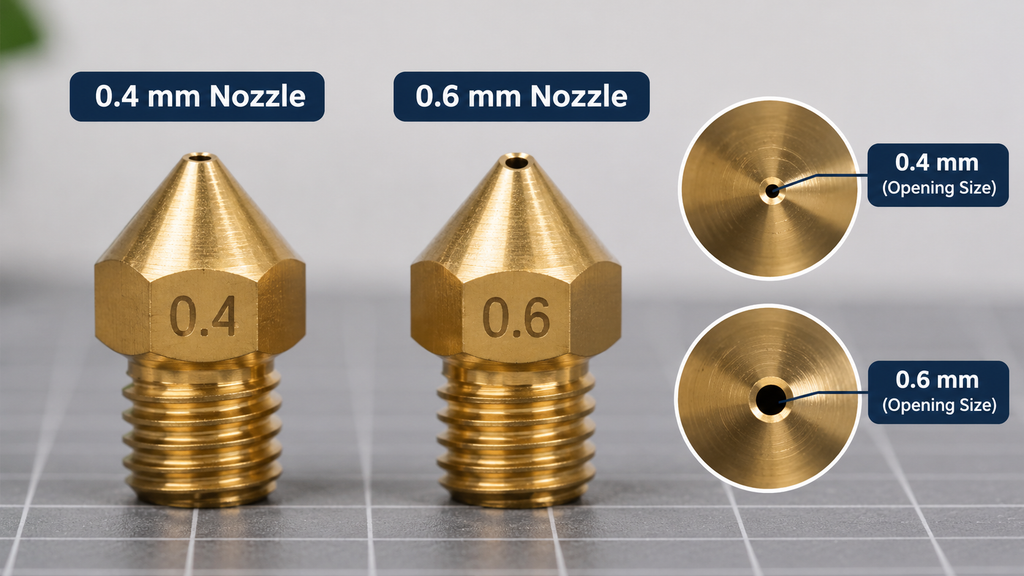
A 3D printer nozzle is the bit that extrudes the molten filament onto the build plate. They come in a range of diameters which will dictate how much material can pass through and will therefore affect the width of each line you get.
The 0.4mm nozzle is by far the most common, providing a good compromise between detail and speed of print. The 0.6mm is a larger nozzle which will extrude more material and therefore can print thicker lines.
What is the Best Nozzle Size?
There’s no one nozzle size that is best for every 3D printing application. The right size will depend on what you’re printing and what you’re trying to achieve.
A 0.4mm nozzle is a very versatile nozzle and is ideal for general purpose printing, for printing detailed models and for printing smaller objects. A 0.6mm nozzle is better for larger prints where you’re after speed and thick extrusion lines rather than detail.
For most general purpose printing 0.4mm is a good starting point. 0.6mm can be worth the switch if you’re regularly printing larger functional parts.
0.4 vs 0.6 Nozzle Strength
Does a larger nozzle give you stronger prints? It can, but it’s not quite that simple.
A 0.6mm nozzle will allow you to print wider extrusion lines and potentially thicker walls. With the right wall count and print settings you can end up with stronger parts.
However, a 0.4 mm nozzle can also produce strong prints when configured correctly. Factors such as layer adhesion, wall thickness, infill, material choice, and print orientation all influence the final strength.
A 0.6mm nozzle can be an advantage for certain functional prints but doesn’t in any way guarantee stronger prints.
0.4 vs 0.6 Nozzle: Key Differences
Print Quality and Detail
A 0.4mm nozzle will generally produce finer detail and is better suited to models with small features, complex designs and such.
A 0.6mm nozzle deposits wider lines and so small details can be less accurate. It can still produce very good prints, particularly on larger models where the fine detail isn’t really an issue.
A 0.6 mm nozzle deposits wider lines, which can make small details less precise. However, it can still produce good-quality prints, particularly for larger models where fine details aren’t a priority.
If appearance and detail matter most, 0.4 mm is usually the better choice.
Printing Speed
Does a 0.6mm nozzle print faster? In general yes.
As it can deposit wider and thicker lines a 0.6mm nozzle can cover more area in fewer extrusion passes and can therefore dramatically reduce print times for larger prints.
A 0.4mm nozzle will generally require more passes to cover the same area and therefore will take longer to print.
However the actual speed gains will be down to your printer’s maximum volumetric flow rate, your filament, your layer height and your slicer settings. Just having a larger nozzle won’t necessarily result in faster printing.
Strength and Durability
Both nozzle sizes will give you durable prints, the 0.6mm nozzle just gives you a bit more flexibility when printing wider walls and thicker extrusions.
This is useful for functional parts that are going to be used regularly. A 0.4mm nozzle can get the same results (albeit with a different wall thickness and a different set of print settings).
The difference really comes down to how the print is set up and designed.
Material Compatibility
A 0.4mm nozzle is fine with the usual filaments (PLA, PETG, ABS etc).
A 0.6mm nozzle can be very useful when printing with materials that have relatively large particles in them (e.g. certain wood filled or fibre filled filaments) as the larger opening reduces the chance of clogging.
However nozzle material does matter. Abrasive filaments will generally require a hardened (or otherwise wear resistant) nozzle rather than a standard brass one.
Want to learn more about Materials? Click here
Which Nozzle Should you Choose?
Now that we’ve covered the main differences, here’s how to decide.
For beginners
A 0.4mm nozzle is a good starting point. It’s very versatile, well supported by a wide range of slicer profiles and will do the job for pretty much any normal print you’re going to do.
Want more beginner-friendly blogs? Click here
For Detailed Prints
If you’re printing miniatures, decorative models or objects with a lot of detail a 0.4mm nozzle is generally the better choice.
For Larger Functional Parts
A 0.6mm nozzle is worth looking at if you’re regularly printing larger items (enclosures, brackets, etc). The wider extrusion lines can help to reduce print time and make it easier to get thick walls.
Frequently Asked Questions
Is a 0.6mm nozzle worth it?
Yes if you’re regularly printing larger objects or prioritise faster printing. If you’re mainly printing detailed models then a 0.4mm nozzle may be better.
Is a 0.4mm nozzle good?
Absolutely. A 0.4mm nozzle is about as good as it gets in terms of a balance between print quality, speed and versatility. It’s a good all rounder for the majority of the things you’ll be printing on a day to day basis.
Is printing with a larger nozzle stronger?
Not necessarily. A larger nozzle will give you wider extrusion lines and potentially thicker walls which in turn can give you more strength in certain circumstances. All of that said, the print settings, the material and the design itself are all going to be very important factors.
Does a smaller nozzle give you more pressure?
A smaller nozzle generally creates greater resistance to filament flow, which can increase the pressure required to extrude material at a given flow rate. However, actual extrusion pressure also depends on temperature, filament properties, and printing speed.
Final Thougths
Both 0.4 mm and 0.6 mm nozzles have their advantages. A 0.4 mm nozzle is an excellent all-rounder for detailed models and everyday printing, while a 0.6 mm nozzle is a worthwhile alternative for larger prints and projects where printing speed matters.
Ultimately, choose the nozzle that best suits your printing needs rather than assuming that a larger nozzle is always better.